
Porcelain Inlays & Onlays
Porcelain Inlays & Onlays: Benefits Applications FAQs Before-and-After Contact Us
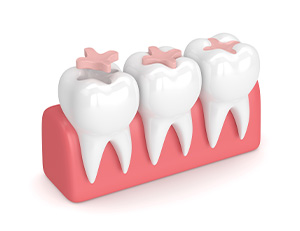
What are porcelain inlays / onlays?
Dental inlays and onlays are restorative dental treatments used to repair teeth that have mild to moderate decay or damage.
Inlays are used instead of composite resin fillings & are made of tooth colored materials such as ceramic/porcelain. Defective & unsightly fillings can be replaced by tooth colored inlays & bonded to the tooth. They are a great remedy for moderate levels of tooth decay that extend into the flossing area. It is a conservative alternative to a full crown. Well fitting, stronger, longer lasting repair for tooth decay or teeth with fractured biting surfaces (cusps).
Inlays/onlays are custom made indirectly in a dental lab. It offers a conservative preparation that preserves as much healthy tooth structure allowing for maximum functional longevity which does not discolor overtime as in the case of composite resin fillings. They are also much better at sealing teeth to keep out bacteria which can lead to decay. It’s superior fit & durable material make them a stable choice.
The Benefits of Porcelain Inlays & Onlays
- Nonsurgical tooth replacement option
- Little to no downtime
- Customizable false teeth to match your smile
- Cost-effective
- Natural-looking results
Common Applications:
Indications for ceramic/porcelain inlays & onlays:
- Moderate tooth decay: Inlays and onlays are used to treat teeth with decay that is too extensive for a dental filling but not severe enough to require a dental crown. They provide a conservative and durable solution for restoring the function and appearance of the tooth.
- Fractured or broken teeth: Inlays and onlays can repair teeth that are fractured or have minor damage, such as cracks or chips, restoring their strength and integrity
- Large old fillings: When a large filling needs to be replaced due to wear, decay, or fracture, an inlay or onlay can be used to provide a more stable and long-lasting restoration than a traditional filling
- Aesthetic concerns: Inlays and onlays are made to match the shade of the tooth. Tooth-colored materials such as porcelain/ceramic provide natural-looking restoration that blend seamlessly with the surrounding teeth.
- Preservation of tooth structure: Inlays and onlays are made to match the shade of the tooth. Tooth-colored materials such as porcelain/ceramic provide natural-looking restoration that blend seamlessly with the surrounding teeth.
- Strengthening weak teeth: Inlays and onlays can strengthen and reinforce weakened teeth, reducing the risk of further damage or fracture.
Overall, dental inlays and onlays are indicated when a more conservative and durable restoration is needed to repair teeth with mild to moderate decay or damage. Your dentist will evaluate your specific dental condition and recommend the most appropriate treatment based on your individual needs.
FAQs
What is the difference between inlays and onlays?
Dental inlays and dental onlays were created to fill large cavities. While both dental inlays and onlays refer to the same type of dental procedure. The difference lies in what part of the tooth is being treated. A dental inlay can be used in cavities at the center of a tooth’s surface, between cusps, or rounded edges. On the other hand, dental onlays are used to treat one or more of the cusps or the entire biting surface of a tooth or teeth. Because dental onlays often cover or replace so much of the tooth, they may be referred to as partial crowns.
What can porcelain inlays / onlays treat?
Dental inlays and onlays can be used to treat a decayed or damaged tooth that is not strong enough to receive a filling. If a filling is failing, painful, or unnatural-looking, porcelain inlays and onlays can be used to restore the shape of the tooth for a beautiful smile. In some cases, using a dental crown on a damaged tooth that could be treated with a porcelain inlay or onlay is unnecessary. Dental crowns are an extremely useful dental tool for unhealthy or damaged teeth but require the tooth to be filed down and much of the tooth to be sanded away. While this is a necessary step if you are experiencing advanced decay or damage, it is often unnecessary to remove so much of the tooth if it can be effectively treated with a porcelain inlay or onlay.
What are the benefits of porcelain inlays / onlays?
Porcelain inlays and onlays help to restore a natural-looking smile without removing too much of your natural tooth. Metal inlays and onlays are unnatural-looking and make your smile seem dull and grey. To avoid a less than natural-looking smile, porcelain inlays and onlays are custom shaded to match your existing teeth perfectly. Additionally, porcelain inlays and onlays strengthen your tooth to reduce the risk of damage, decay, or fractures.
Does Dr. Classi replace porcelain inlays / onlays?
If you have received metal inlays or onlays from another dentist, Dr. Classi can work with you to restore your white smile with porcelain inlays and onlays. Dr. Classi can remove inlays and onlays that are made out of metal, improperly placed, or that cause discomfort. When placing porcelain inlays and onlays, Dr. Classi takes every precaution possible to ensure that your results are beautiful, even, and, above all else, natural-looking.
How can I get started with porcelain inlays / onlays?
Dr. Classi would be happy to discuss porcelain inlays / onlays with you. To learn more about porcelain inlays / onlays with Dr. Anthony Classi at Classi Smiles, please request an appointment online or call our dental office at 212.682.3313.
Before & After Smile Gallery
From the Blog
Read the latest news, insights, and updates.

The Secret to Lifelong Teeth Whitening
Have you ever noticed your attention being instantly drawn to peoples’ teeth when they smile at you? Some people have dull and yellowing teeth, while others have teeth that appear bright white. Everyone’s teeth naturally dull over time because of aging and the contact...
"*" indicates required fields
PATIENT INFORMATION
What You Can Expect
On Your First Visit
Individualized care, experience you can trust, and a personalized plan to attain the smile of your dreams.